

Extraordinary Use Cases — What Agentic AI Actually Enables in Healthcare

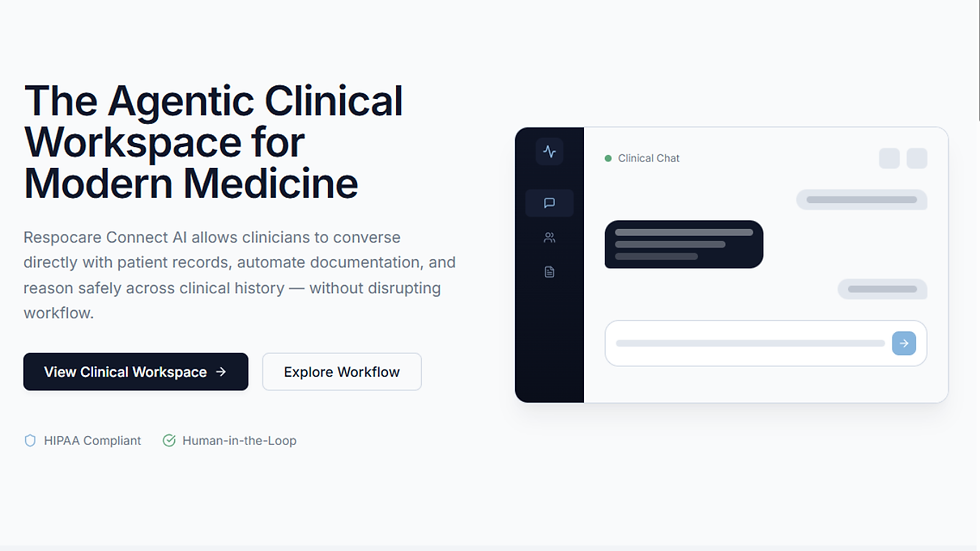
Beyond Automation, Toward Clinical Intelligence That Grows With the User in Agentic AI healthcare
One of the most common questions we hear about agentic clinical AI is deceptively simple:
“What can it actually do?”
The most honest answer is also the least convenient for traditional product narratives:
It depends on the clinician.
Not because the system is vague or underpowered, but because agentic AI does not impose fixed workflows, predefined outputs, or narrow task boundaries. Instead, it provides structured intelligence that adapts to how clinicians think, practice, and evolve over time.
This article explores the real use cases emerging in practice in Agentic AI healthcare — not as features, but as capabilities that traditional healthcare AI systems cannot support by design.
Capability Map: What Agentic Clinical AI Enables
Capability Category | What It Enables in Practice | Why Traditional AI Falls Short |
Longitudinal Clinical Reasoning | Sees the patient journey over time, preserving trends, decisions, and rationale across encounters | Treats notes as isolated events with no temporal continuity |
Context-Aware Recall | Surfaces relevant history, imaging, and prior decisions without explicit prompting | Requires precise prompts or manual reconstruction of context |
Clinical Scribing With Reasoning | Produces structured notes that reflect assessment logic, not just dictated words | Focuses on transcription rather than clinical cognition |
Clinician-Controlled Workflows | Adapts to how each clinician works without enforcing rigid pathways | Enforces templates and fixed sequences |
Reasoned Safety & Uncertainty Signalling | Makes uncertainty explicit and respects diagnostic boundaries | Relies on hard rules or blanket refusals |
Cross-Domain Clinical Synthesis | Connects data across imaging, physiology, symptoms, and MDT input | Operates within single data silos |
Adaptive Intelligence Over Time | Grows in usefulness as the clinician’s sophistication increases | Locked to predefined use cases and outputs |
Why Traditional Healthcare AI Reaches a Ceiling
Most healthcare AI tools fall into familiar categories: task automation, static decision support, or narrowly trained prediction models. These systems can be useful, but they are limited by their structure.
They are built around single encounters, fixed prompts, predefined pathways, and output-first logic. They perform well when the question is already known and neatly framed.
Clinical reality is rarely like that.
Agentic AI is different because it is not defined by a task. It is defined by how intelligence is organised across time, context, and intent — closer to how clinicians actually work.
What Makes Agentic Clinical AI Fundamentally Different
Agentic systems are built around four foundational ideas: persistent clinical memory, context-aware reasoning, goal-directed assistance within boundaries, and clinician-controlled workflows.
Because of this, their most powerful use cases do not look like features you can toggle on or off. They look like new ways of working that emerge once intelligence is structured differently.
Longitudinal Clinical Reasoning
Seeing the Journey, Not the Visit
Traditional AI treats each clinical note as an isolated object. Agentic AI treats the patient record as a continuous narrative.
This allows the system to reason across months or years, track disease progression, compare baseline and follow-up investigations, and preserve not only what decisions were made, but why they were made.
This matters because clinical decisions depend on trends, response, and history — not snapshots. Longitudinal reasoning is essential for chronic disease management, follow-up clinics, and multidisciplinary care, and it cannot be reliably achieved by encounter-based systems.
Context Without Prompting
Intelligence That Surfaces What Matters
Most AI systems wait for clinicians to ask the right question. Agentic systems reduce that burden.
Relevant history, prior investigations, and earlier decisions can surface automatically, shaped by the current clinical task — whether that is review, referral, or follow-up. Context is recalled without forcing clinicians to reconstruct it manually.
This matters because cognitive load is one of the strongest contributors to clinical fatigue and error. By bringing context forward quietly and appropriately, agentic AI supports clarity without interruption or distraction.
Medical AI Scribing Beyond Transcription
Preserving Clinical Reasoning, Not Just Words
Traditional AI scribes focus on converting speech into text. Agentic AI focuses on clinical structure and reasoning.
Instead of producing raw transcripts, the system organises information according to clinical logic, preserves assessment rationale, and maintains consistency across notes over time. Documentation aligns naturally with formats such as SOAP notes, referrals, or discharge summaries.
Clinical notes are not transcripts. They are legal records, cognitive tools, and professional communication artefacts. Agentic scribing supports how clinicians think, not merely how they speak.
Workflow Ownership Remains With the Clinician
No Enforced Pathways
Many clinical systems attempt to standardize care by enforcing steps, templates, or sequences. Agentic AI does not.
Clinicians remain free to work in their preferred order. There are no locked workflows or rigid templates. Intelligence adapts to specialty, style, and context, following intent rather than clicks.
Medicine is practiced differently across disciplines and settings. Agentic AI respects that diversity instead of flattening it into a single workflow model.
Safety Through Reasoning, Not Restriction
Boundaries Without Blocking
Traditional safety mechanisms often rely on hard refusals and rigid rules. Agentic AI introduces reasoned restraint.
Uncertainty is explicitly signalled. Diagnostic boundaries are respected.
Recommendations stop where evidence stops. Clinician authority remains intact.
Safety in healthcare is not achieved by silencing intelligence. It is achieved by making uncertainty visible and reasoning transparent, allowing clinicians to make informed decisions with appropriate support.
Cross-Domain Clinical Insight
Reasoning Between Data Sources
Agentic AI is not confined to a single data type or modality. It can reason across imaging, physiology, symptoms, functional data, and multidisciplinary conclusions.
Clinical insight often lives between data sources, not inside them. Agentic systems are designed to operate in that space, supporting synthesis where human clinicians already work — but with far greater continuity and recall.
Intelligence That Grows With the User
The Defining Capability
The most misunderstood aspect of agentic AI is this:
The system does not define the ceiling. The clinician does.
As clinicians become more comfortable and sophisticated in their use, new applications emerge naturally. Intelligence adapts without artificial limits imposed by predefined use cases.
This is why agentic AI resists feature lists. It is not a tool with fixed outputs. It is an intelligence layer that evolves alongside the clinician.
Why These Are Not “Productivity Features”
These capabilities are not simple efficiency gains. They are clinical thinking enablers.
Agentic AI does not tell clinicians what to do. It helps them see more clearly, reason more safely, and decide more confidently — while remaining fully in control.
Why It’s Hard to Define What Agentic AI Can Do
If you are looking for a definitive list of everything agentic AI can do, you will not find one.
The most powerful use cases emerge after deployment, shaped by clinicians rather than product teams.
That is not a limitation.
It is the point.
Closing Reflection
Agentic AI is not about replacing clinical intelligence. It is about building systems that respect it, support it, and scale with it.
At Respocare Connect AI, we believe the future of healthcare AI belongs to systems that grow alongside clinicians — not systems that attempt to contain them.
And that changes what is possible.


Comments