

Will Home Oxygen Therapy Make Me Housebound?

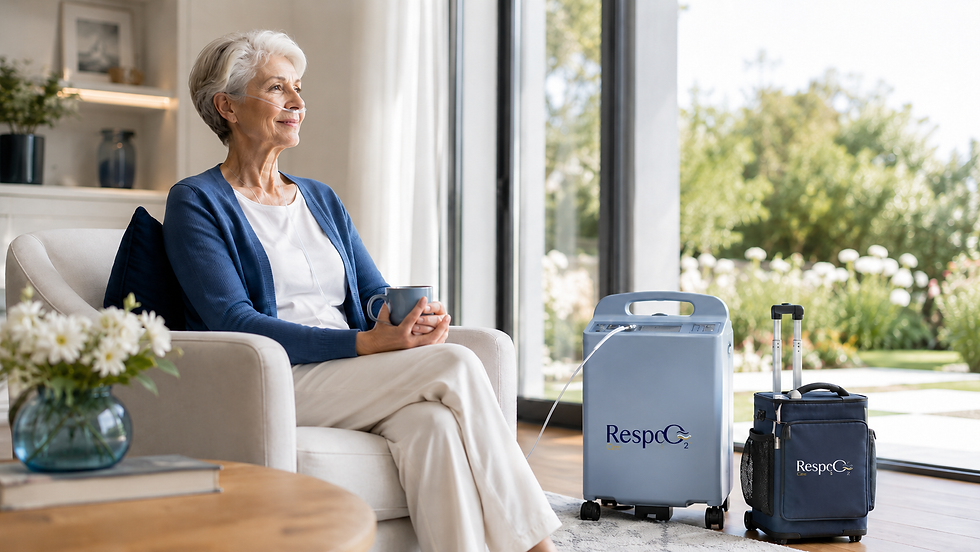
Being prescribed home oxygen can bring relief, but it can also create uncertainty. Many patients understand that oxygen has been recommended to support their health, yet still worry about how it may affect their everyday lives.
One of the most common concerns is whether using oxygen will make it difficult to leave the house. Patients may imagine being permanently connected to a large machine, unable to visit family, attend appointments or continue with ordinary activities. Others worry about electricity interruptions, running out of oxygen, using the wrong setting or feeling self-conscious in public.
These concerns are understandable. Starting home oxygen therapy involves learning how to use unfamiliar equipment and adjusting to a new routine. However, home oxygen does not automatically mean losing your independence. The right oxygen system should be selected according to both your medical needs and the way you live.
For some patients, a stationary oxygen concentrator may provide the oxygen they need while they are at home. For others, portable oxygen may also be appropriate, allowing them to leave the house with greater confidence. The most important point is that every oxygen device must match the prescription given by the treating healthcare professional.
Understanding why Home Oxygen Therapy is prescribed
Home oxygen is prescribed when the lungs are unable to maintain sufficient oxygen levels in the blood. This can happen in people living with conditions such as chronic obstructive pulmonary disease, interstitial lung disease, pulmonary fibrosis or other serious heart and lung conditions.
The purpose of oxygen therapy is to provide the body with additional oxygen when it cannot obtain enough through normal breathing. Oxygen may be prescribed for continuous use, during physical activity, while sleeping or only at certain times of the day.
The amount of oxygen required is different for every patient. A doctor or respiratory healthcare professional may assess oxygen levels while the patient is resting, walking or sleeping before deciding on the appropriate flow rate and hours of use.
This is why oxygen should be treated as prescribed medical therapy rather than a general comfort measure. The setting should not be changed without clinical advice, even when a patient feels more breathless than usual.
Why patients worry about becoming housebound
A standard home oxygen concentrator is generally designed to remain inside the home. It draws in surrounding air, removes much of the nitrogen and delivers concentrated oxygen to the patient through tubing and a nasal cannula.
Because the machine usually depends on electricity and is not designed to be carried around, patients can easily assume that they will need to remain close to it throughout the day. This may lead to anxiety about leaving home, attending appointments or spending time with other people.
In some cases, the fear of managing oxygen outside the house becomes more restrictive than the equipment itself. A patient may begin avoiding outings because they are unsure whether they have enough oxygen, whether the battery will last or how other people will react.
These concerns should be addressed as part of the patient’s oxygen plan. A patient who wants or needs to remain mobile should be encouraged to discuss portable oxygen with their healthcare professional or oxygen provider.
When portable oxygen may help
Portable oxygen is designed to support patients who require oxygen while away from home. Depending on the prescription, this may involve a portable oxygen concentrator, a lightweight oxygen cylinder or another ambulatory oxygen system.
For a suitable patient, portable oxygen may make it easier to attend medical appointments, visit family, complete essential shopping or take part in appropriate daily activities. It can also reduce some of the anxiety associated with leaving the home while dependent on oxygen therapy.
Respocare generally recommends that patients who are concerned about becoming housebound ask whether portable oxygen can be included in their treatment plan. However, portable oxygen is not automatically appropriate for every patient, and not every portable device provides the same type or amount of oxygen.
The device must be able to meet the patient’s prescribed requirements while resting and during activity. A machine should not be chosen only because it is light, attractive or easy to carry.
Not all portable oxygen machines are the same
Portable oxygen concentrators vary considerably. Some can provide continuous-flow oxygen, while many provide oxygen using pulse-dose delivery.
Continuous-flow oxygen is delivered steadily, whether the patient is breathing in or out. Pulse-dose oxygen is released in small amounts when the device detects that the patient has started to inhale.
These delivery methods are not interchangeable. A pulse-dose setting of three does not necessarily provide the same amount of oxygen as three litres per minute from a continuous-flow source.
This distinction is particularly important for patients with higher oxygen needs, shallow breathing or difficulty triggering a pulse-dose device. It may also matter during sleep and physical activity.
Battery life, weight and maximum oxygen output also differ between devices. A small portable concentrator may be convenient, but it may not be suitable for a patient who requires a higher flow rate or continuous oxygen.
The best portable oxygen machine is therefore not simply the smallest or newest device. It is the one that can safely provide the oxygen prescribed for that particular patient.
Can a person become addicted to oxygen?
Some patients are concerned that once they begin using oxygen, their lungs will become weaker or their bodies will become dependent on the machine.
Oxygen is not addictive. A patient needs oxygen because an underlying health condition is preventing the lungs from maintaining adequate oxygen levels. The medical condition creates the need for oxygen; the treatment does not create the condition.
A patient may notice that they feel worse when they remove their oxygen. This does not mean they have developed an addiction. It may mean that their oxygen level is falling back to where it was before the treatment was applied.
Patients should not reduce or stop prescribed oxygen because they are worried about becoming dependent on it. Any decision to change oxygen use should be made with the treating healthcare professional.
Feeling self-conscious about oxygen in public
Using a nasal cannula or carrying an oxygen device can make a health condition more visible. Some patients worry that other people will stare, ask questions or assume that they are seriously unwell.
This may cause embarrassment, particularly during the early stages of oxygen therapy. Some patients may avoid leaving home even when portable equipment is available because they do not feel comfortable being seen using it.
These feelings often improve as the patient becomes familiar with the equipment. Beginning with shorter outings may help. A nearby appointment, a brief visit with family or a short walk can allow the patient to build confidence gradually.
Family members and caregivers can also provide reassurance by treating the oxygen system as a normal part of the patient’s healthcare. Prescribed oxygen is not something a patient should feel ashamed of using. It is a treatment intended to support the body and help the patient function more safely.
Planning for electricity interruptions
Electricity supply is an important consideration for any patient using a stationary oxygen concentrator. Because the machine normally requires power to operate, there should be a clear backup plan in case the electricity goes off.
The appropriate backup arrangement will depend on how much oxygen the patient uses, how long they can safely remain without the concentrator and whether power interruptions are common in their area.
Some patients may be supplied with a backup oxygen cylinder. Others may use an approved alternative power solution or a combination of equipment. The plan should be discussed with the oxygen provider and treating healthcare professional.
The patient and family should know how to operate the backup system before an interruption occurs. They should understand how to open the cylinder, how to select the prescribed flow and approximately how long the available oxygen will last.
They should also know whom to contact if the interruption continues or if the backup supply is running low. A plan is only effective when the people in the home understand it.
Preventing portable oxygen from running out
Patients using oxygen outside the home should plan for the duration of each outing.
Cylinder users need to understand how to check the contents of the cylinder and estimate how long it will last at the prescribed flow rate. Portable concentrator users should know the expected battery duration at their prescribed setting.
Battery life may change depending on the oxygen setting, the condition of the battery and the way the device is being used. Higher settings may reduce the amount of time a battery lasts.
Before leaving home, patients should check that the device is working correctly and that the battery is charged or the cylinder contains sufficient oxygen. Longer outings may require an additional battery or backup oxygen supply.
Unexpected delays should also be considered. An appointment may run late, traffic may be heavier than expected or access to a charging point may be limited. Planning for additional time can reduce stress and help the patient feel more confident.
Using the correct oxygen setting
The prescribed oxygen setting is based on an individual clinical assessment. It is not simply a number chosen according to how breathless the patient feels.
Breathlessness and low oxygen levels are not always the same thing. A person may feel short of breath because of anxiety, infection, physical exertion, heart problems or progression of an underlying illness. Increasing the oxygen flow without advice may not solve the problem and may be unsafe for some patients.
Similarly, patients should not lower their oxygen setting to make a cylinder or battery last longer. This could mean that the body is receiving less oxygen than prescribed.
The safest approach is to use the setting recommended by the treating healthcare professional. When portable oxygen is introduced, the patient may need to be assessed while walking or performing normal activity with the actual device.
This helps confirm whether the equipment can maintain the required oxygen level outside the home.
What to do if breathlessness becomes worse
Oxygen therapy does not always remove every feeling of breathlessness. It is used to treat low oxygen levels, but breathlessness may have several causes.
Patients should contact their doctor or treating team if their breathing becomes noticeably worse, if their normal oxygen no longer appears to help or if they seem to require more oxygen than usual.
Urgent medical attention may be necessary if the patient develops sudden or severe breathing difficulty, chest pain, confusion, unusual drowsiness or blue or grey discolouration around the lips. Help should also be sought if the patient is unable to speak comfortably because of breathlessness.
The oxygen provider can assist with equipment problems, but changes in the patient’s medical condition must be assessed by an appropriate healthcare professional.
Using oxygen safely in the home
Home oxygen can be used safely when the correct precautions are followed.
Oxygen itself does not burn, but it causes other materials to ignite more easily and burn more intensely. Smoking near oxygen equipment is therefore extremely dangerous.
Nobody should smoke or vape close to a patient using oxygen. The equipment should also be kept away from candles, open fires, gas stoves, heaters and other sources of heat or sparks.
Oxygen cylinders should be stored upright and secured so that they cannot fall. The concentrator should be kept in a well-ventilated area and should not be covered while operating.
Patients should avoid
using petroleum-based products around the nose, face or oxygen equipment unless these have been specifically approved for use with oxygen. Oils and grease should also be kept away from cylinder valves and fittings.
Tubing should be arranged carefully to reduce the risk of tripping. Patients and family members should pay particular attention to doorways, passages and areas where the tubing crosses the floor.
These precautions should become part of the patient’s routine. The purpose is not to make oxygen therapy frightening, but to ensure that it is used safely and consistently.
Choosing an oxygen system for everyday life
The right oxygen system depends on more than one factor.
The prescription is the starting point, but the patient’s daily routine also matters. Someone who spends most of the day at home may have different equipment needs from someone who attends regular appointments or remains active in the community.
The provider should consider whether the patient needs oxygen continuously, during sleep, during activity or at specific times. The required flow rate and method of oxygen delivery must also be considered.
Practical questions are equally important. Can the patient carry the device? Will a caregiver help? How long does the patient usually spend away from home? Is electricity reliable? Is backup oxygen available? Does the patient need to use the system while travelling?
There is no single machine that is suitable for every person. In some cases, a stationary concentrator combined with a portable concentrator may be appropriate. In other cases, a stationary concentrator and portable cylinders may provide a safer and more practical solution.
Patients with higher oxygen needs may require specialised equipment that is less compact but more capable of delivering the prescribed oxygen.
The aim should be to find a system that supports both the patient’s medical needs and daily routine.
Why proper setup and education matter
Receiving oxygen equipment should involve more than delivery.
The patient should be shown how to switch the equipment on, connect the tubing, set the prescribed flow and recognise common alarms. They should understand how to clean the equipment and when filters, cannulas or tubing may need attention.
Where a backup cylinder is supplied, the patient and family should be shown how to use it. Portable oxygen users should receive clear instructions about battery charging, expected operating time and travelling with the device.
The patient should also know who to contact when there is a problem. This may include situations where the concentrator stops working, the battery no longer charges, the cylinder is running low or an alarm continues sounding.
Clear education reduces anxiety. It gives the patient greater control over the treatment and helps prevent avoidable equipment problems.
How Respocare supports home oxygen patients
Respocare has worked in oxygen therapy and patient support for more than a decade. During that time, we have seen that the success of home oxygen depends not only on the equipment, but also on how well the patient understands and manages it.
Our role is to help patients and families understand the oxygen system that has been prescribed. This includes setting up the equipment correctly, explaining how it works and helping the patient prepare for practical situations such as electricity interruptions and leaving the home.
We also encourage patients who are concerned about losing mobility to discuss portable oxygen. Where it is clinically appropriate, portable oxygen may help the patient attend appointments, visit family and remain involved in everyday life.
Our recommendation is always based on suitability rather than convenience al
one. A portable device must be capable of meeting the patient’s actual oxygen requirements.
The patient should not have to choose between safety and independence. The goal is to find the most appropriate balance between the two.
Home oxygen does not have to make life smaller
Starting oxygen therapy can require a significant adjustment. Patients may need time to become comfortable with the equipment and confident in their daily routine.
It is reasonable to worry about leaving the house, running out of oxygen or being seen using a nasal cannula. These concerns should be discussed rather than ignored.
For patients who are clinically suitable, portable oxygen may provide a practical way to remain mobile. It can help reduce the feeling of being confined to the home and make essential outings easier to manage.
However, every portable device has limits. The equipment must match the prescribed flow, oxygen-delivery method and expected level of activity.
Good oxygen care brings these factors together. It considers the prescription, the equipment, the patient’s home environment and the activities that matter to them.
At Respocare, we believe home oxygen should be provided as an ongoing service rather than a once-off equipment transaction. The patient should feel informed, supported and able to ask for help when needed.
The purpose of oxygen therapy is not simply to place a machine in the home. It is to help the patient use prescribed oxygen safely and confidently while maintaining as much independence as their health allows.
Medical information notice: This article provides general educational information and does not replace advice from a doctor or respiratory healthcare professional. Never change an oxygen setting, flow rate or equipment plan without appropriate clinical guidance.


Comments