

From Automation to Agentic AI: Why Prompting Separates the Two

Introduction — Why Prompting Is Central to Agentic AI in Healthcare

As artificial intelligence becomes embedded into healthcare, a quiet but consequential debate is emerging beneath the surface:
Will Prompting in healthcare AI disappear as AI systems become more advanced — or is it a permanent feature of clinical intelligence?
In many AI product discussions, prompting is treated as a temporary inconvenience. A user-interface problem to be refined away once systems are sufficiently autonomous, safe, or regulated. This assumption may hold in consumer technology. In medicine, it does not.
Healthcare is not a domain where intelligence can be delivered passively. Clinical reasoning is iterative, contextual, and accountable. Decisions are rarely made in a single step, and uncertainty is not an error state — it is a condition that must be managed deliberately.
Agentic AI systems introduce a fundamentally different relationship between humans and machines. These systems do not simply automate tasks or recommend actions. They reason, adapt, and respond to direction. Prompting is the mechanism through which clinicians provide that direction.
Crucially, prompting is not about telling the system what to do.It is about expressing clinical intent — what matters, what is uncertain, what must be compared, and what must not be assumed.
When prompting is constrained at the level of access rather than governed at the level of infrastructure, the very nature of agentic AI is compromised. Intelligence becomes boxed, exploration is limited, and clinical reasoning is flattened into predefined pathways.
This article sets out to explain why prompting is not a transitional feature of healthcare AI, but a foundational one — and why preserving open, responsible access to intelligence is essential for building safe, clinically aligned agentic systems.
Access the Intelligence, Don’t Wait for Permission
Agentic AI is not something you understand by reading about it.It is something you experience by using it freely, responsibly, and clinically.
Respocare Connect AI — Free Demonstration Now Live
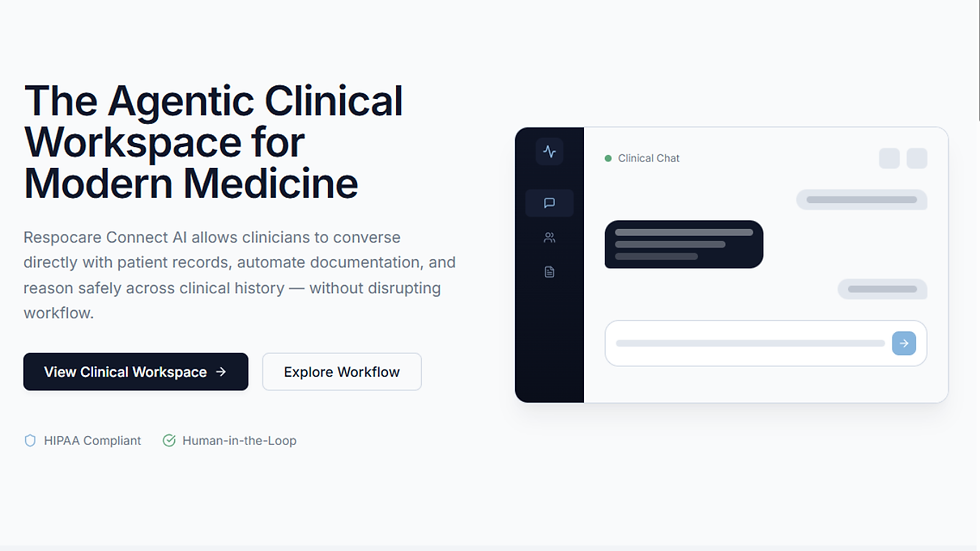
We have opened a free live demonstration of Respocare Connect AI for medical professionals who want to see what true agentic intelligence feels like in a clinical setting.
This is not a scripted demo. No fixed workflows. No button-only interactions.
It is a real agentic system designed to:
Respond to clinical intent
Support longitudinal reasoning
Surface uncertainty, not hide it
Preserve clinician authorship
This is your opportunity to experience what happens when intelligence is governed by infrastructure — not restricted at the interface.
Respocare Insights — Premium Weekly Guide on Clinical Prompting
Starting soon, Respocare Insights Premium will launch a weekly course-style guide for medical professionals focused entirely on one critical skill:
How to prompt agentic AI safely, effectively, and clinically.
This is not “prompt engineering.”It is a practical, clinician-led guide covering:
How to direct AI reasoning without biasing it
How to explore uncertainty responsibly
How to stress-test outputs in real clinical scenarios
How to think with agentic systems — not around them
Delivered weekly, written for medical professionals, grounded in real clinical workflows.
Learn how to access intelligence properly — before restrictive systems decide for you.
Section 1 — Why Prompting in healthcare AI Matters More in Healthcare Than Any Other Domain
Healthcare is not a domain where intelligence can be delivered in finished form.
Clinical reasoning unfolds through iteration — not execution. A clinician does not arrive at understanding by asking a single question or accepting a single output. They refine, narrow, broaden, challenge, and reframe continuously, often within the same consultation.
Prompting is the mechanism that enables this process when working with agentic AI.
Unlike transactional software, healthcare AI must accommodate ambiguity, partial data, and competing hypotheses. Prompting allows clinicians to declare intent explicitly: what they are exploring, what they are excluding, and what level of certainty is acceptable at a given moment.
In medicine, the question is often more important than the answer. Prompting preserves this hierarchy. It ensures that the clinician remains the author of the clinical narrative, while the AI functions as an adaptive reasoning partner rather than a directive authority.
Removing or constraining prompting in healthcare AI does not simplify decision-making. It removes the clinician’s ability to safely interrogate intelligence — a capability that is foundational to patient care.
Section 2 — Agentic AI Is Not Automation: It Is Shared Intelligence
Much of the confusion around prompting stems from a misunderstanding of what agentic AI actually is.
Automation replaces steps.Agentic AI supports thinking.
Traditional healthcare AI systems are designed to execute predefined workflows or surface recommendations within tightly controlled parameters. While useful, these systems operate on the assumption that intelligence can be fully specified in advance.
Agentic AI rejects this assumption.
In an agentic system, intelligence is distributed. The system reasons across data, memory, and context — but the clinician retains control over direction, framing, and interpretation. Prompting is the interface through which this shared intelligence is exercised.
Without prompting, an agentic system cannot adapt to the nuances of real clinical work. It becomes a static decision-support tool, incapable of responding to evolving hypotheses or unexpected findings.
Prompting is not a workaround for incomplete automation. It is the defining feature that allows intelligence to remain flexible, responsive, and aligned with clinical judgment.
Section 3 — The Critical Mistake: Guardrailing Access Instead of Infrastructure
As healthcare AI adoption accelerates, a subtle but consequential design error is becoming increasingly common: guardrailing the clinician’s access to intelligence rather than governing the intelligence itself.
This usually presents as fixed workflows, pre-approved prompts, limited query types, or tightly constrained interfaces designed to “reduce risk.” While well-intentioned, this approach misunderstands where risk actually resides in clinical AI systems.
True safety does not come from limiting what clinicians are allowed to ask.It comes from controlling what the system is allowed to retrieve, combine, and assert.
Infrastructure-level guardrails operate beneath the interface and include strict data entitlements, patient-level isolation, validated retrieval sources, audit trails, and explicit uncertainty signaling. These controls ensure that the AI system behaves safely regardless of how it is prompted.
Access-level guardrails, by contrast, cap the clinician’s ability to explore, interrogate, and challenge the system. When access is restricted, intelligence is artificially constrained. The system may appear safer, but it is in fact more brittle — unable to respond appropriately to real-world clinical complexity.
Agentic AI requires freedom at the access layer and discipline at the infrastructure layer. Reversing this balance undermines the very properties that make agentic systems clinically valuable.
Section 4 — Why Restricting Prompts Increases Clinical Risk (Not Safety)
Restricting prompts is often framed as a safety measure. In practice, it produces the opposite effect.
When clinicians are limited to predefined questions or workflows, uncertainty becomes obscured rather than managed. The system appears more confident than it should, and edge cases are quietly excluded from consideration.
More importantly, constrained prompting encourages workarounds. Clinicians will seek answers outside the system when they cannot ask the questions they need, fragmenting context and undermining auditability. This erodes trust and shifts responsibility away from transparent, reviewable interactions.
Clinical safety depends on the ability to stress-test reasoning. Prompting allows clinicians to challenge assumptions, explore alternative explanations, and explicitly ask what the system does not know. Removing this capability does not eliminate risk — it removes visibility into it.
An agentic AI system must be able to tolerate scrutiny. Prompting is how that scrutiny is applied. Without it, the system may function smoothly in controlled scenarios, but it will fail precisely where clinical judgment matters most.
Section 5 — Prompting Is a Clinical Skill, Not a Technical One
Prompting is often misunderstood as a technical competency — something clinicians must learn in order to “use” artificial intelligence effectively. This framing misses the point.
Prompting is not about knowing special syntax or mastering a new interface. It is about expressing clinical intent clearly and deliberately.
When a clinician prompts an agentic AI system, they are engaging in the same cognitive processes that underpin everyday medical practice: directing attention, prioritising signals, articulating uncertainty, and testing assumptions without committing to action.
These behaviours are not new. What is new is the scale and speed at which intelligence can now respond to them.
As AI systems become capable of reasoning across longitudinal records, multimodal data, and complex clinical histories, the clinician’s ability to guide that reasoning becomes increasingly important. Prompting is how clinicians decide what matters now, what can wait, and what must not be assumed.
Seen through this lens, prompting is not an obstacle to adoption. It is the interface that preserves clinical authorship and accountability in an era of machine intelligence.
Section 6 — Infrastructure Is Where Guardrails Belong
The safest healthcare AI systems are not those that restrict clinician interaction. They are those that are rigorously governed beneath the surface.
Infrastructure-level guardrails define what an AI system is permitted to access, retrieve, and reason over — independent of how it is prompted. This includes patient-level data isolation, entitlement-based access controls, validated retrieval sources, and persistent audit trails.
By enforcing safety at the infrastructure layer, agentic systems remain resilient even under complex or unconventional lines of inquiry. Clinicians can prompt freely, knowing that the system cannot overstep its authorised boundaries or fabricate unsupported conclusions.
This separation of concerns is critical. The system is responsible for data integrity, provenance, and uncertainty signalling. The clinician is responsible for interpretation and decision-making.
When these roles are clearly defined, prompting becomes safe, productive, and clinically aligned.
Agentic AI does not require less freedom at the interface. It requires stronger foundations beneath it.
Closing — Preserving Intelligence in the Age of Agentic AI
(SEO focus: future of AI in healthcare, agentic AI systems, Respocare Connect AI)
The question facing healthcare is not whether artificial intelligence will become more powerful. That trajectory is already clear.
The real question is who will be allowed to access that intelligence — and how.
Agentic AI does not exist to replace clinical thinking or to collapse medicine into predefined pathways. Its value lies in its ability to respond to human intent: to be questioned, redirected, challenged, and reframed as clinical understanding evolves.
Prompting is the mechanism that makes this possible. It is not a flaw to be engineered away, nor a transitional interface waiting to disappear. It is the access layer through which clinicians engage with intelligence responsibly.
When prompting is constrained at the level of access, intelligence is artificially limited. Exploration becomes unsafe, uncertainty is hidden, and clinical reasoning is flattened. The system may appear more controlled, but it is less aligned with real medicine.
The alternative is clear.
Guardrails belong in infrastructure — in data entitlements, retrieval boundaries, auditability, and uncertainty signaling. Access belongs with the clinician. When this balance is respected, agentic AI becomes not only safer, but more clinically meaningful.
At Respocare Connect AI, our position is deliberate and uncompromising: intelligence must remain accessible to the clinician. We design systems that are governed beneath the surface and open at the point of use, preserving clinical authorship, accountability, and trust.
Agentic AI will not succeed by narrowing what clinicians are allowed to ask.
It will succeed by supporting how clinicians already think — and by giving them the freedom to do so, responsibly, at scale.

Comments